























Stories
We're thick skinned
I worried about strangers' cruel stares, but my girls take it in their stride...
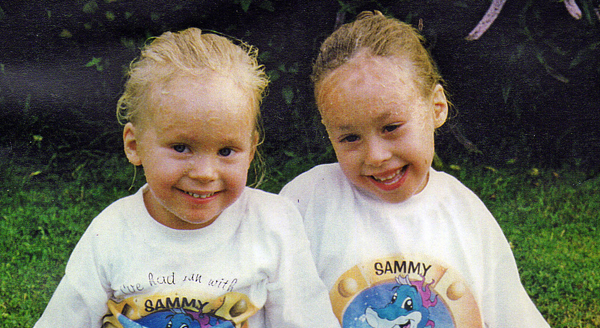
That sinking feeling came over me as I watched a woman approach me and my wife Sarah, 39, in the street. Stopping in front of our double buggy, she smiled.
‘Mind if I take a peek?’ she asked, bending over the pram where our one-year-old Emma and her newborn sister Stacey sat.
I knew what was coming next…
‘Oh, they’re…’ the woman’s smile faltered and she flinched in shock. ‘Er… beautiful,’ she finished, unconvincingly.
As she hurried off, I sighed miserably. ‘People are always going to look at them like that, aren’t they?’ I turned to Sarah. ‘They’ll always be judged for what they look like.’
She gazed back at me sadly.
I’d been positive Emma was a boy before she’d been born, but that hadn’t been the only surprise when she’d arrived…
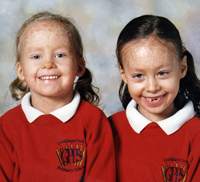
‘What’s wrong with her skin?’ I’d gasped, horrified at the sight of my beautiful little girl covered in blotchy, red, flaky scales, like a snake shedding its skin. Her chest had been pulled in tight, as if her skin was a thick elastic band squeezed around her ribs. She’d hardly been able to breathe.
Doctors had whisked her off to intensive care, leaving me and Sarah in pieces, waiting for news.
After tests, we’d been given the diagnosis. ‘Emma has a rare genetic condition called lamellar ichthyosis, which affects one in 600,000 people,’ her doctor had told us. ‘Her skin grows six times faster than normal.’
This increased growth had also caused the skin around her chest to tighten so much it had restricted her breathing.
For two weeks, she’d been kept in hospital on a ventilator and was bathed daily in E45 moisturising cream to help soften her skin.
Thankfully, it had worked and soon she was able to breathe normally.
But taking her home hadn’t changed the fact that her skin condition was permanent.
We had to keep her out of the sun because she couldn’t sweat – her skin was too thick – and that meant there was a danger she’d overheat. We had to moisturise her daily, too.
It quickly became our routine.
When Stacey had been born a year later with the same rare skin condition, me and Sarah had been absolutely devastated.
What did the future hold for our little girls? How would they cope with being singled out by narrow-minded, insensitive people?
Months passed, and we muddled through, trying our best to ignore the odd looks we got when we went out.
All I wanted to do was wrap them in cotton wool, hide them from the cruel stares.
But, to my surprise, as the girls grew older, they didn’t seem worried by it at all.
Every day, we had to spray them with water to stop their skin drying out.
‘Let me have a go!’ Emma giggled happily, squirting her sister.
‘It tickles,’ Stacey chuckled.
Then Emma cheekily turned the spray on me!
‘Got you!’ she cried, laughing loudly. ‘Now Daddy’s like us.’
 They just got on with life. The next second they were back playing with their dolls, like any other girls their age.
Still, it didn’t stop me from worrying about them. On Emma’s first day at school, I was a mess. What if she got picked on?
It turned out I needn’t have worried. She came home full of beans. ‘Look what I drew, Daddy!’ she squealed, holding up a colourful finger-painting.
‘Wow!’ I smiled proudly. ‘Did you have fun?’
She nodded eagerly. ‘I made some friends in class,’ she beamed.
Of course, as the years rolled by, Emma and Stacey still got funny looks. Me and Sarah had to go to their school a few times when they were bullied because of their condition.
One day, when she was 12, Stacey came home in tears.
‘A boy at school called me corn flake girl and scabby,’ she sobbed. Although they moisturised every day, their skin was thick and cracked – it looked almost scaly.
This was exactly what I’d been afraid of. But, before I could say a word, Emma was standing by her sister, hands on hips.
‘Next time he bothers you, come and tell me,’ she said firmly. ‘I’ll tell him where to go.’
In utter amazement, I realised how independent and strong my girls were. In spite of everything. Emma had turned into a feisty teenager. Determined and headstrong, she refused to put up with any nonsense.
A few weeks later, Stacey surprised me, too, as she got ready for a day out with pals.
‘You’ll need your moisturiser, a long-sleeved top and a hat just in case the sun comes out…’ I said.
Stacey rolled her eyes. ‘I’ve got all those things,’ she sighed, showing me her bag. ‘What I mustn’t forget is my new eye shadow though. I’m going to do everyone’s make-up. I want to be a make-up artist when I grow up.’
I shook my head, chuckling in sheer disbelief. They might have had to put up with a lot over the years, but beneath it they were still teenage girls, still worried about their hair and make-up, even boys!
‘I’m not going with Stacey today,’ Emma interrupted my thoughts. ‘I’ve got a date. We’re going to the cinema and I need something nice to wear.’
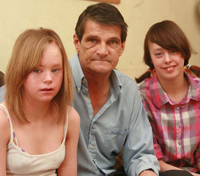
Watching her scamper up to her room to root through her wardrobe, I no longer felt that familiar pang of anxiety.
I’d been so worried they’d never live normal lives, worried everyone would treat them like outsiders. But Emma and Stacey’s personalities shone through and won people over.
Emma also wanted to reassure people who faced similar problems to her.
When she found a camp in America for kids with her condition, it gave her an idea.
‘I want to set one up over here,’ she said. ‘Not just for people with our skin condition, but anyone who looks different and doesn’t want to be judged. There are loads of people worse off than us.’
Emma is now 17 and Stacey is 15. They’ve grown into such beautiful girls – inside and out.
Now, my heart doesn’t sink when I think about my girls’ future, it swells with pride.
Steve Picken, 52, Newton Aycliffe, County Durham
Story search...
Story archive
Just added...
From chunky to hunky
Cuddly Colin was too roly-poly to...
read more...
The boy of steel
With his baby sister Holly to love,...
read more...
The great Moggy mystery
Just what was making all of our cats...
read more...
Most popular...
Quick reads...
No choccie, but life's so sweet!
I'm a reformed chocoholic...
read more...
Baa-ck from the dead!
My heart bleated for these poor sheep...
read more...
Brave undertaking
I've swapped cars for coffins...
read more...